

7 Upwork Proposal Mistakes That Quietly Kill Your Win Rate
Fix these common Upwork proposal mistakes: generic openers, proof-free pitches, pricing traps, bad formatting, and follow-up fails that cost you clients.

You might be skilled and still lose—not because clients hate you, but because your proposal trains them to doubt you in the first ten seconds. The mistakes below are extremely common because they feel safe. They are polite, professional, and forgettable.
Fix these, and your win rate often jumps before you change anything else.
Mistake 1: Opening with a resume summary
Clients do not wake up wanting your biography. They want confirmation you understood their task.
Fix: Lead with their goal, in their words. Only after that, anchor proof.
Bad: “I am a passionate developer with 8 years…”
Better: “You need a Laravel API hardened against common auth edge cases—here’s how I’d approach the audit and fixes.”
Mistake 2: Proof that is not proof
“Expertise,” “quality work,” and “attention to detail” are not evidence. They are filler.
Fix: Use one tight story: what you built, what constraint you handled, what changed afterward.
If you are newer, use a portfolio sample with a clear explanation of what it demonstrates—honesty plus craft beats empty claims.
Mistake 3: Ignoring explicit instructions
Some posts include tests: a keyword in the first line, a question to answer, a file to review. Missing these is an automatic filter.
Fix: Treat instructions like a contract. Build a mini checklist from the job post and verify it before you submit.
This sounds basic—and that is why it separates pros from the mass-applicants.
Mistake 4: The “everything I can do” skill dump
Long lists signal insecurity. They also bury the one skill that matters for this job.
Fix: Highlight 2–4 relevant skills maximum. Tie each one to a deliverable in the posting.
Mistake 5: Vague pricing theater
Clients dislike confusion. If you quote, be clear what the quote includes. If you cannot quote yet, say what you need to estimate—and propose a paid discovery step when appropriate.
Fix: Separate what you can commit now from what depends on unknowns. Clients respect clarity.
Mistake 6: Wall-of-text formatting
Dense paragraphs are hard to skim on mobile. Many clients review proposals on their phone.
Fix: Short paragraphs. Bold sparingly (if the platform allows). Bullet points for deliverables or steps.
Read your proposal aloud. If you run out of breath, it is too long in one chunk.
Mistake 7: No next step
Ending with “I am available for any questions” puts the mental load on the client. You want to reduce decision friction.
Fix: Suggest a concrete next step: a 15-minute call, a Loom, a milestone proposal—whatever matches the job size.
Bonus mistake: copying templates without editing
Templates are fine as scaffolding. They fail when the client can tell you did not read the job.
Fix: Always customize the hook and the plan. Those two sections should be impossible to reuse verbatim elsewhere.
The mindset shift that fixes half of this automatically
Treat each proposal as a mini sales letter for one buyer, not a broadcast email to “the market.”
That shift changes:
- Your opening lines (specific vs generic)
- Your proof (curated vs everything)
- Your tone (confident vs needy)
How workflow tools reduce these mistakes
Most proposal failures are not talent problems—they are fatigue problems. When you rush, you revert to generic openers and skill dumps.
A sane workflow—saved job criteria, structured notes, reusable proof blocks—helps you apply when you are fresh and keep quality consistent. Browser extensions and dashboards are useful when they reduce friction without pushing spammy automation.
Mistake 8: “Impressive” jargon that hides unclear thinking
Clients are not impressed by vocabulary—they are impressed by clear plans. If you describe work in buzzwords without a deliverable list, you look like a risk.
Fix: Translate jargon into outcomes: what ships, when, and what the client receives.
Mistake 9: Apologizing for normal business
Freelancers sometimes apologize for rates, boundaries, or asking questions. Boundaries are professionalism.
Fix: Be polite, neutral, and clear. “Here’s what’s included” is not rude—it is helpful.
Mistake 10: No differentiation
If your proposal could be sent by 200 other freelancers, you are competing on luck.
Fix: Add one differentiation layer: niche experience, a unique process, a relevant risk callout, or a tighter milestone plan.
A quick self-audit rubric (score yourself)
Rate each proposal 1–5 on:
- Specificity to the job post
- Proof quality
- Clarity of next steps
- Instruction compliance
- Skimmable formatting
If any category is a 2, revise before sending.
Mistake 11: Competing on “availability” alone
“I am available 24/7” is not believable—and even if it were, it signals unsustainable work habits.
Fix: Offer realistic availability: time zone, response windows, and weekly update rhythm. Professionals have boundaries; amateurs perform desperation.
Mistake 12: The “me-first” proposal
If the first half of your proposal is about you, the client has not yet learned why you matter to their outcome.
Fix: Flip the ratio: job first, proof second, credentials only as supporting evidence.
When mistakes are actually market mismatch
Sometimes you write a good proposal and still lose because the job was not your game. That is not an excuse to avoid improvement—but it is a reason to track categories separately.
Track:
- win rate by niche
- win rate by job size
- reply rate by client type
If one niche consistently fails, fix positioning or stop applying there.
A 7-day improvement plan (simple)
- Day 1: Rewrite your top 3 proof snippets to include outcomes
- Day 2: Delete filler adjectives from your default draft
- Day 3: Add a milestone line to every proposal
- Day 4: Run the instruction checklist on every application
- Day 5: Shorten paragraphs; improve mobile readability
- Day 6: Review your last 10 proposals; find the repeated weak opener
- Day 7: Update your profile line so it matches your best proposal hook
Small upgrades stack.
Conclusion
Your win rate improves when proposals become easier to trust: specific, evidence-backed, instruction-following, skimmable, and clear about next steps. Cut the filler, respect the client’s time, and make every application feel like it was written for that job—because it was.
Many of these mistakes happen in a hurry on the apply page. ProposalLift's Chrome extension drafts on that page with the persona and portfolio you choose and fills in the proposal field, and you review it before you click submit.
Recent blog posts
 Sep 15, 2026
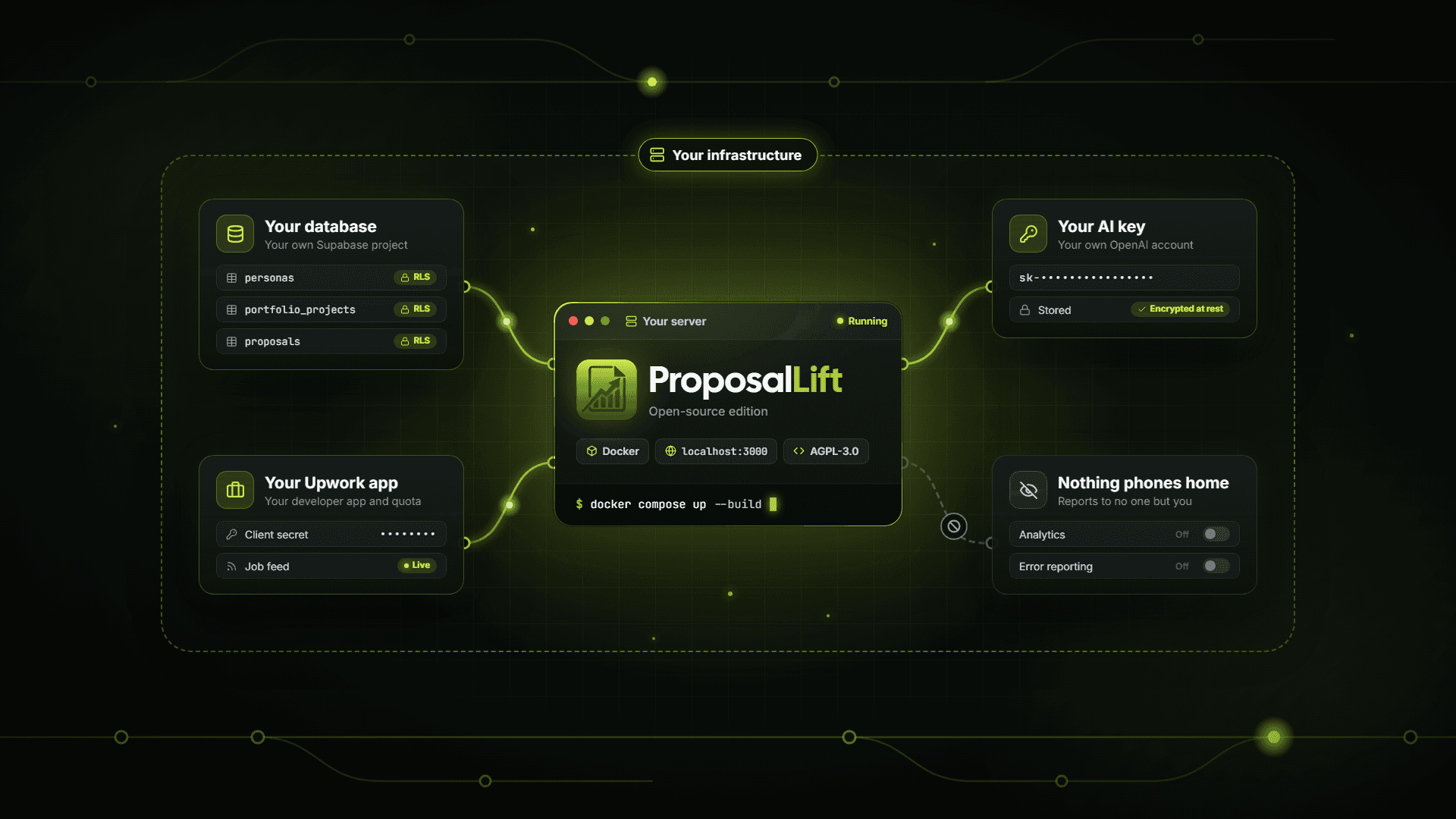
ProposalLift Open Source: A Self-Hosted AI Proposal Writer for Upwork
ProposalLift now has a free, open-source edition you can run on your own server. What it includes, how to set it up, and when hosted plans are the better fit.
 Apr 21, 2026
How to Write Upwork Proposals That Actually Get Hired (2026 Guide)
Learn how to write Upwork proposals that stand out: structure, proof, tone, and mistakes to avoid—plus a repeatable workflow serious freelancers use daily.
 Apr 20, 2026
Upwork Cover Letter Template That Converts (Copy-Paste Framework)
Use this Upwork cover letter framework: opening hook, proof, plan, and CTA—plus examples you can adapt so you sound credible, not like spam or a template.