

How to Write Upwork Proposals That Actually Get Hired (2026 Guide)
Learn how to write Upwork proposals that stand out: structure, proof, tone, and mistakes to avoid—plus a repeatable workflow serious freelancers use daily.

Most Upwork proposals fail for one boring reason: they sound like everyone else. The client is skimming dozens of messages that open with “Hi, I am a highly motivated professional…” and close with “I look forward to hearing from you.” If your proposal could be swapped with a generic template and nobody would notice, you are not competing—you are blending in.
This guide breaks down how to write Upwork proposals that feel specific, credible, and easy to hire.
What clients are really scanning for
Clients do not read proposals like essays. They scan for:
- Relevance — Did you understand the job in their words?
- Proof — Have you done something similar, with outcomes?
- Clarity — Can you explain your approach without jargon dumping?
- Low risk — Do you sound dependable, communicative, and easy to work with?
Your job is to pass that scan in the first screen of text.
The proposal structure that works on Upwork
Use a simple four-part structure. It keeps you focused and makes your message skimmable.
1. Anchor to the job (first 2–3 lines)
Repeat the client’s goal in plain language. If they want a Next.js dashboard with Stripe billing, say that—not “web development services.”
Example angle: “You’re looking for a Next.js admin dashboard integrated with Stripe subscriptions and role-based access—here’s how I’d approach the first milestone.”
This immediately signals: I read your post.
2. Show you understood constraints
Pull out 1–2 details from the posting: timeline, stack, audience, deliverables, or a worry they hinted at (performance, SEO, accessibility, legacy code).
Example: “Since you mentioned the MVP must ship in three weeks, I’d prioritize a thin vertical slice: auth + billing + one core workflow, then iterate.”
3. Proof in one tight block
Use a mini case pattern: Situation → what you did → measurable outcome.
Bad: “I have 10 years of experience.”
Better: “Last month I shipped a similar Stripe + Next.js flow; checkout errors dropped after we added server-side validation and webhook retries.”
If you are newer, proof can be a strong portfolio piece, a personal project with metrics, or a clear plan for a paid test task.
4. Next step + question
End with a specific next step: a short call, a Loom walkthrough, or a small paid discovery milestone—whatever fits the job size.
Ask one smart question that shows expertise. Not “What is your budget?” unless they truly left it unclear. Prefer: “Do you already have Stripe Connect requirements, or is standard Checkout enough for v1?”
Tone rules that increase replies
- Be confident, not desperate. Avoid begging, excessive exclamation points, or “sir/madam.”
- Be warm, not robotic. Write like a competent colleague, not a press release.
- Be concise. Long proposals are not impressive; tight proposals respect the client’s time.
Common mistakes that tank win rates
- Copy-pasting the same opener for every job. Clients can tell instantly.
- Leading with your life story before you address their task.
- Buzzword stacking (“synergy,” “passionate,” “hardworking”) with no evidence.
- Ignoring instructions like answering screening questions inside the proposal when the client asked for them in a specific format.
- Pricing games that feel evasive. If you quote, quote clearly—or explain what you need to quote accurately.
A practical weekly habit (high leverage)
Pick 5–10 jobs that truly fit your skills. For each one, spend 15 minutes customizing the first half of the proposal. That is where clients decide to keep reading.
Track what you changed: which lines got replies, which niches convert, which hooks flopped. Over a month, you will build a library of opening lines that are yours—not recycled from the internet.
How tools fit in (without replacing judgment)
Automation can help you move faster on research and first drafts—especially when you are juggling a job feed, client work, and admin. A browser extension paired with a dashboard can pull job context, keep personas and hooks consistent, and stop you from submitting tired copy when you are tired.
But the win still comes from specificity. Tools should shorten the path from “I read this job” to “here is a tailored plan”—not generate proposals so generic that clients ignore them.
Fixed-price vs hourly proposals: what changes in the message
You do not need two personalities. You need two clarity modes.
Fixed-price jobs reward explicit scope thinking. Clients want to know what “done” means. Your proposal should name deliverables, what is out of scope, and what you need to start (assets, access, decisions). If the post is fuzzy, propose a small paid discovery milestone—this is not “lowering your value,” it is preventing a messy engagement.
Hourly jobs reward process thinking. Clients want reassurance you will not waste time. Your proposal should emphasize communication cadence, how you track tasks, and how you handle unknowns. Proof should highlight similar engagements where you shipped iteratively.
A before/after rewrite (same freelancer, different results)
Before (generic): “Hello, I am a full-stack developer with many years of experience. I can do your project perfectly and I am ready to start immediately.”
After (specific): “You need a customer portal where users can upload PDFs, see processing status, and download results—plus admin tools to re-run failed jobs. I’ve built similar async job pipelines with queued workers and status webhooks; the main risk is upload edge cases and large file handling, so I’d start with a thin upload + status loop before expanding admin tooling. I can share a Loom of a related project if helpful.”
The second version is hireable because it is concrete. It does not prove everything—it proves competence in the right neighborhood.
Proposal “QA” checklist (60 seconds)
Before you submit, answer:
- Did I quote the client’s goal using their vocabulary?
- Did I include at least one proof point tied to a similar deliverable?
- Did I mention a milestone or next step?
- Did I follow every instruction in the posting?
- If I quoted a price, can I defend what is included?
If you cannot check “proof,” do not pad with adjectives. Add a portfolio link, a sample plan, or a smaller paid first step.
Frequently asked questions
Should I write a long proposal to show effort?
Usually no. Effort shows as specificity, not length. A tight 180-word proposal often beats a 600-word essay.
Should I mention I am new to Upwork?
Only if it is relevant—and frame it as enthusiasm, not insecurity. Otherwise, let proof speak.
What if the client has no reviews?
Treat it as higher uncertainty, not automatic avoidance. Tight milestones, clear communication, and payment protections matter more than “perfect history.”
Conclusion
Strong Upwork proposals are not clever tricks. They are evidence that you understood the job, can execute, and will be easy to work with. Lead with relevance, prove it fast, keep the tone human, and iterate based on what gets replies.
If you apply this structure consistently, you will outperform freelancers who spray identical cover letters at every listing—because you will sound like someone who actually read the post.
When you are ready to apply this structure to every job, ProposalLift's Upwork proposal generator drafts from the job post, your persona, and the portfolio projects that best match it. You stay in control: every proposal is reviewed and submitted by you.
Recent blog posts
 Sep 15, 2026
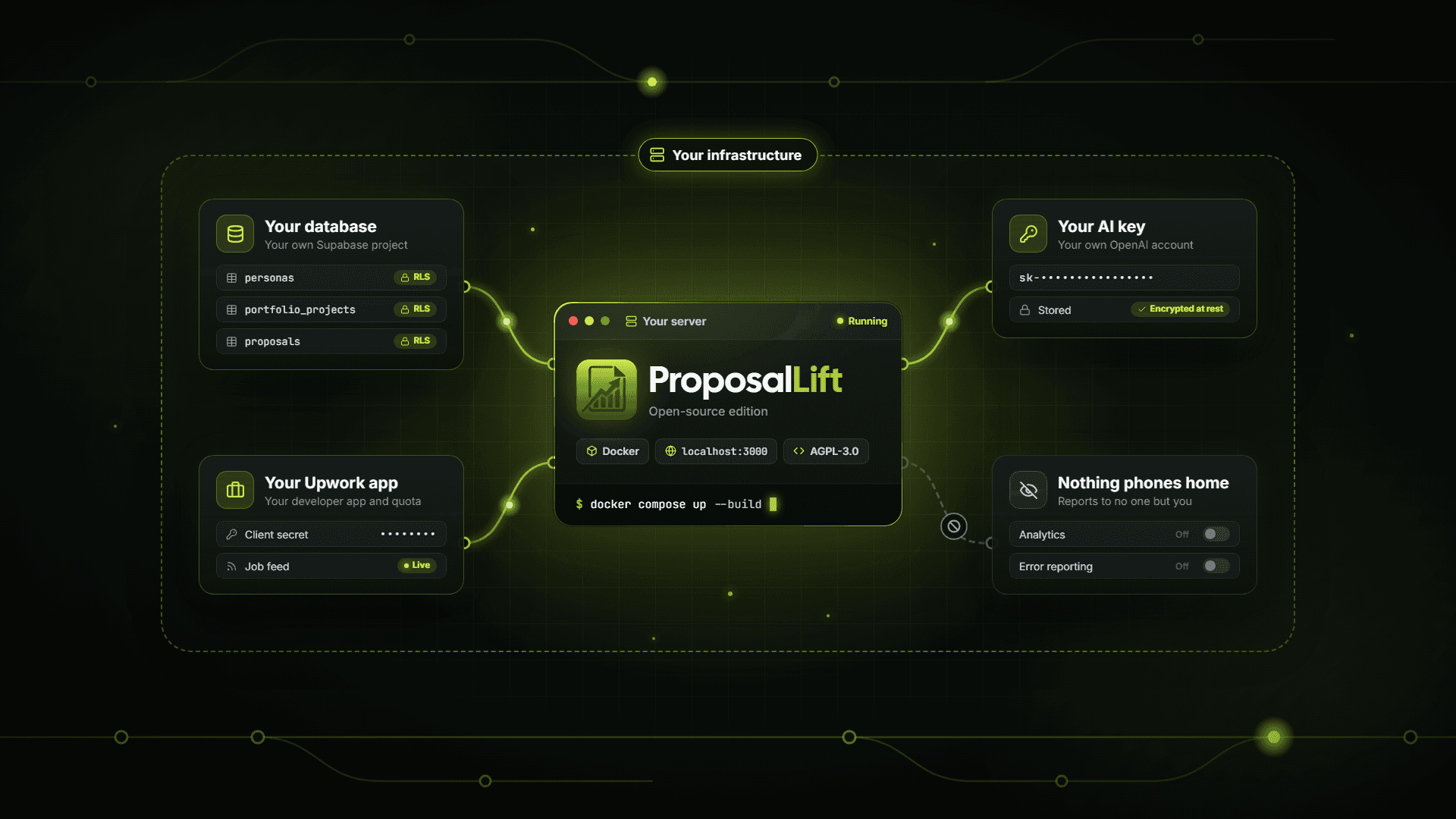
ProposalLift Open Source: A Self-Hosted AI Proposal Writer for Upwork
ProposalLift now has a free, open-source edition you can run on your own server. What it includes, how to set it up, and when hosted plans are the better fit.
 Apr 20, 2026
Upwork Cover Letter Template That Converts (Copy-Paste Framework)
Use this Upwork cover letter framework: opening hook, proof, plan, and CTA—plus examples you can adapt so you sound credible, not like spam or a template.
 Apr 19, 2026
Freelance Proposal Automation: Smart Workflow (Without Sounding Robotic)
Use proposal automation the right way: research, snippets, checklists, and job feeds—while keeping every Upwork proposal specific enough to win consistently.