

Upwork Profile Optimization: More Invitations, Better Clients
Optimize your Upwork profile for search and trust: title, overview, skills, portfolio storytelling, rates, and alignment with proposals—so invites improve.

Your proposals get you into conversations, but your profile closes the trust gap—especially when clients compare finalists or when Upwork surfaces you for invitations. Profile optimization is not about stuffing keywords; it is about making your value obvious in seconds and credible in minutes.
This guide focuses on changes that affect invites and conversion: clarity, proof, and alignment between what you say and what you sell.
The first screen rule: assume nobody scrolls at first
Clients often decide whether to keep reading based on:
- Your photo (professional, clear)
- Your title (specific)
- The first two lines of your overview (outcome-oriented)
If your opening lines are generic, many clients never reach your portfolio—no matter how good it is.
Title: specific beats sprawling
Weak pattern: listing twelve skills separated by slashes.
Strong pattern: one primary outcome + niche.
Examples of directionally strong titles (adapt to your reality):
- “Shopify Performance & CRO for DTC Brands”
- “B2B SaaS Landing Pages + Onboarding Email Sequences”
- “Next.js + Node APIs for Early-Stage SaaS MVPs”
You can include secondary nuance, but the reader should instantly know what to hire you for.
Overview: write a sales letter, not a biography
A useful structure:
- Who you help (customer type)
- What you deliver (tangible outputs)
- Why you are credible (experience style—without dumping your entire life story)
- How you work (communication, collaboration)
- Call to action (invite to discuss a project)
Keep paragraphs short. Use bullets for deliverables if it improves skimmability.
Portfolio: fewer items, stronger stories
Each portfolio piece should answer:
- What problem existed?
- What did you do?
- What was the result?
If you cannot share exact metrics, share qualitative outcomes and scope details. “Designed a website” is weak. “Built a 6-page marketing site with CMS, integrated analytics events, and improved mobile LCP” is stronger.
Order matters: put the most relevant work first for the jobs you want next.
Skills: match the work you want, not every skill you ever learned
Over-stuffing skills can confuse the algorithm and humans. Prioritize:
- Skills tied to your flagship offer
- Skills clients actually search
If you list skills you do not want to be hired for, you may attract wrong-fit invites.
Rates: signal professionalism, not desperation
Your rate communicates positioning. Too low can attract problematic buyers; too high without proof can reduce responses.
A practical approach:
- Anchor to market reality for your niche (as best you can infer)
- Adjust for experience and proof
- Use your proposal to justify value when needed
If you are newer, you might price slightly lower intentionally—but still use clean packaging: milestones, boundaries, and professionalism.
Specialization invites vs generalist invites
Generalists sometimes get volume invites—but often poor-fit spam. Specialists tend to get fewer, better invites.
If you want better clients, specialization usually beats “I do everything.”
SEO on Upwork: natural language beats keyword stuffing
Use phrases clients actually type, but write like a human. Mention:
- Tools
- Industries
- Deliverables
…naturally in overview and portfolio descriptions.
Avoid repeating the same keyword unnaturally; it reads untrustworthy.
Credibility without client work (honest paths)
If you have limited platform history:
- Strong personal projects
- Open-source contributions
- Certifications that matter in your niche
- A clear “sample project” section labeled honestly
Do not fake client work. Platform trust is long-term.
Align profile and proposals (consistency compounds)
If your proposal says you are a “technical SEO for local service businesses,” your profile should not look like a generic web dev shop. Mismatches create doubt.
After you tune your positioning, update:
- Title
- Overview first lines
- Portfolio ordering
- Skills
Activity signals: responsiveness matters
Invites also correlate with how reliably you operate on-platform. Fast, professional responses to messages help—both for algorithmic signals and human trust.
Test changes with a simple experiment log
When you update your profile, record:
- Date changed
- What changed
- Invites per week (and quality)
If you change ten things at once, you will not know what worked.
Where tooling connects to profile work
Freelancers often maintain multiple positioning assets: personas, offer statements, portfolio blurbs, and proposal hooks. A centralized system—especially when paired with job context from a feed or extension—helps you keep messaging consistent across profile, proposals, and portfolio.
Consistency is not “salesiness.” It is proof you know what you do.
Common profile mistakes that hurt invites
- Vague opening lines (“I am hardworking…”)
- Huge skill lists with no coherent offer
- Portfolio items with no explanation
- Typos in the first paragraph (it signals carelessness for detail-oriented work)
Invitations: quality over quantity
More invites are not automatically better. You want relevant invites from buyers who match your offer.
If you get spammy invites, tighten your title and overview language so the algorithm and humans understand your niche. If you get no invites, improve proof visibility and keyword alignment—without turning your profile into a keyword pile.
Testimonials and social proof (use them cleanly)
If you have off-platform testimonials, use them ethically:
- keep claims accurate
- avoid fake reviews (obviously)
- prefer short quotes tied to outcomes
Even one strong testimonial can lift trust if it matches what you sell now—not what you sold five years ago.
Profile + proposal alignment example
If your proposals emphasize “technical SEO for local service businesses,” your profile should mention:
- local SEO
- service business experience
- measurable SEO outcomes
If your profile emphasizes something else, you create cognitive dissonance—clients feel something is “off” even if they cannot name it.
Conclusion
Upwork profile optimization is mostly clarity plus proof: a sharp title, a skimmable overview, portfolio stories with outcomes, skills aligned to your offer, and rates that match your positioning. Make your profile match your best proposals, measure invites over time, and iterate like a product—not a one-time renovation.
Your profile and your proposals should tell the same story. ProposalLift keeps your personas, portfolio, and hooks consistent across every proposal you draft, so the positioning you set here carries into each application.
Recent blog posts
 Sep 15, 2026
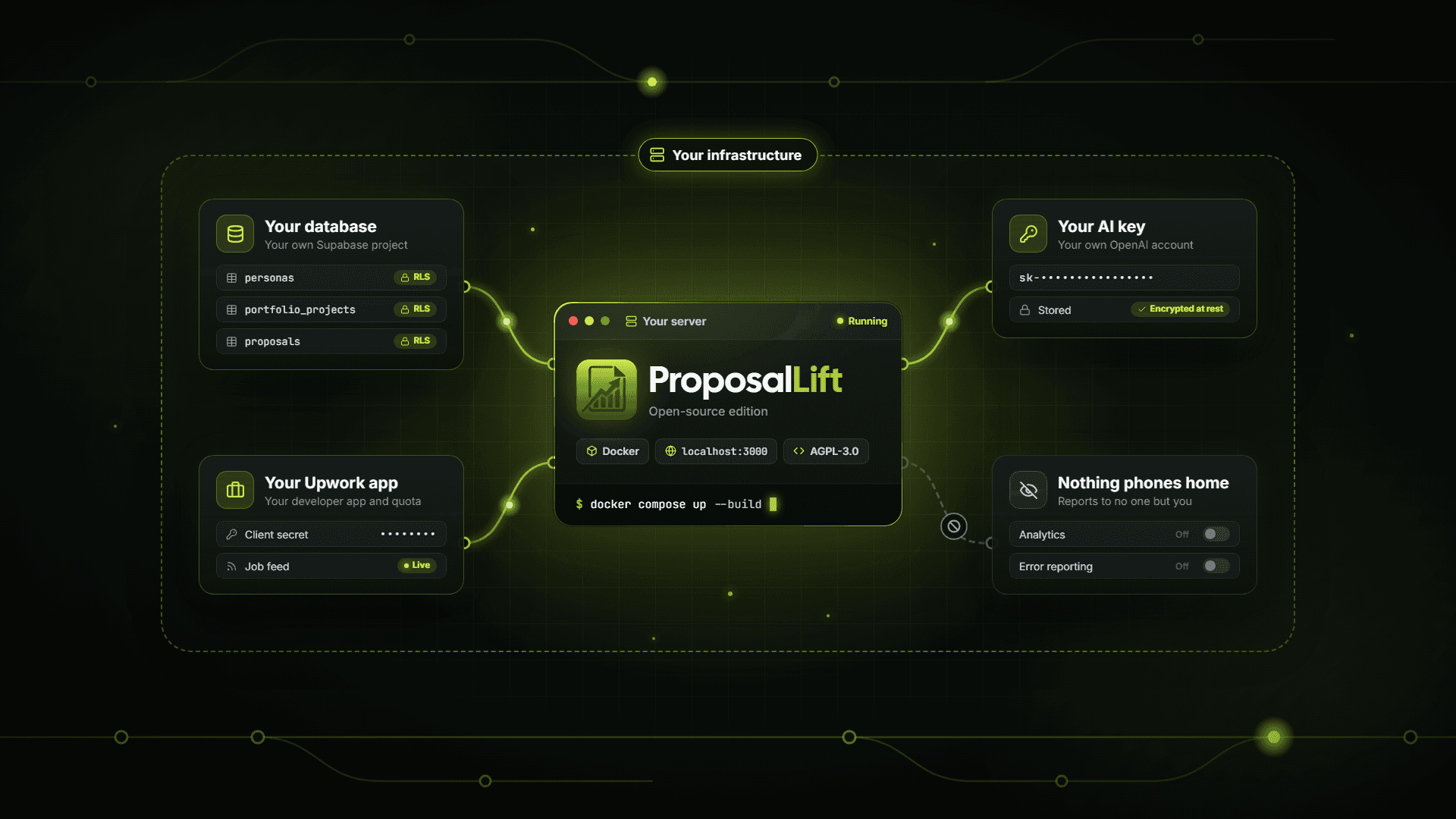
ProposalLift Open Source: A Self-Hosted AI Proposal Writer for Upwork
ProposalLift now has a free, open-source edition you can run on your own server. What it includes, how to set it up, and when hosted plans are the better fit.
 Apr 21, 2026
How to Write Upwork Proposals That Actually Get Hired (2026 Guide)
Learn how to write Upwork proposals that stand out: structure, proof, tone, and mistakes to avoid—plus a repeatable workflow serious freelancers use daily.
 Apr 20, 2026
Upwork Cover Letter Template That Converts (Copy-Paste Framework)
Use this Upwork cover letter framework: opening hook, proof, plan, and CTA—plus examples you can adapt so you sound credible, not like spam or a template.