

How to Get Clients to Reply to Your Upwork Proposal (Proven Tips)
Increase Upwork reply rates: stronger hooks, better proof, smarter questions, timing, and professional follow-ups—without sounding desperate or spammy.

A proposal that does not get a reply is not always a “bad” proposal. Sometimes the client hired fast, paused hiring, or got overwhelmed. But if your reply rate stays low across many applications, the issue is usually message quality, targeting, or timing—not bad luck alone.
This guide focuses on practical levers: how to earn replies from busy clients who are skimming fast.
Understand what “reply” really means on Upwork
Replies are not the end goal; they are signals. You want messages that start a conversation leading to clarity, scope, and a contract.
So optimize for:
- Curiosity (they want to ask you something)
- Confidence (you seem low-risk)
- Ease (replying feels simple)
Tip 1: Your first sentence should be impossible to confuse with spam
Spam proposals are generic. Your opener should reference something only this job would contain: a tool, a constraint, a deliverable name, a timeline, a niche audience.
Exercise: Delete your first sentence. Ask: could this sentence apply to ten other jobs? If yes, rewrite.
Tip 2: Replace adjectives with evidence
“Highly skilled” is invisible. Evidence is memorable:
- A metric (even directional)
- A before/after
- A named deliverable similar to theirs
If you cannot cite client work, cite a credible personal project—clearly labeled—and explain why it is relevant.
Tip 3: Ask a question that feels like expertise—not an interview
Bad questions feel like chores:
- “Can you tell me more about the project?” (too vague)
Better questions show you know the terrain:
- “Are you expecting V1 to support team roles, or single-user accounts only?”
- “Do you already have brand guidelines, or should I include a lightweight style pass?”
One great question beats five mediocre ones.
Tip 4: Match the job’s decision stage
Some clients are exploring; some are ready to hire today. Your proposal should match:
- Exploration: Offer a small paid milestone or audit.
- Ready-to-hire: Be direct about start date, first deliverable, and what you need to begin.
Misreading the stage makes you look either pushy or unserious.
Tip 5: Make replying mentally cheap
Busy clients reply when it is easy. Give them:
- A suggested time window for a call (with time zone)
- A clear option: “If you prefer async, I can respond to these three questions in chat.”
Reduce friction.
Tip 6: Timing matters (but do not obsess)
Applying early can help visibility, but quality beats being first with garbage. A practical approach:
- Build a routine: check alerts on a schedule you can sustain.
- Prioritize high-fit jobs immediately.
If you use a curated job feed or alerts, you reduce the chance you only see great jobs after they are saturated.
Tip 7: Follow-ups: rare, respectful, useful
Not every platform interaction allows follow-up the way email does, and spamming clients is a reputation risk. When follow-up is appropriate, make it short:
- Restate interest in one line
- Add one new piece of value (insight, relevant example)
- Ask one clean question
No guilt trips. No novels.
Tip 8: Fix your profile if replies die at the next step
Sometimes clients open your proposal, then check your profile—and go silent. Common profile leaks:
- Confusing title
- Weak portfolio ordering
- Skills that do not match the story you tell in proposals
Align proposal + profile so the client’s second click confirms the first impression.
Tip 9: Segment your markets and measure reply rate by niche
Your reply rate is not one number. It differs by category.
Track:
- Niche / service type
- Job size
- Client history (new vs established)
You might discover you get replies in one niche at double the rate—then double down.
Tip 10: Stop applying to “zombie jobs”
Some posts are stale, duplicated, or never seriously hiring. Indicators vary, but if you repeatedly get zero replies on certain sources, change sourcing:
- Improve filters
- Focus on clients with clearer intent
- Avoid categories where you cannot demonstrate proof
Example: turning a weak proposal into a reply-friendly one
Weak: “Hello sir, I am expert developer. I can do your project perfectly. Please hire me.”
Stronger: “You need a Python script to clean and merge three CSV sources weekly so your team stops doing manual Excel work. I’ve built similar ETL utilities using pandas + scheduled runs; the key is validation rules so bad rows are quarantined instead of silently poisoning outputs. If you share sample files (redacted), I can propose exact validation checks and a delivery timeline.”
The second version gives the client something to react to.
Tools: help your brain, not replace it
Reply rates climb when you consistently send specific proposals. Tools can help by storing job snippets, organizing proof blocks, and speeding up drafting from structured notes—especially when you pair a browser extension with a dashboard for tracking what you applied to.
Automation that pushes generic text does the opposite: it trains you to sound like everyone else.
A simple weekly improvement loop
Every Friday, review:
- Which proposals got replies?
- What did those jobs have in common?
- What was different about the hook?
Adjust one variable next week. Small iterations compound.
Reply killers you might not notice
Sometimes you do everything “right” and still get silence. Look for hidden issues:
- Your thumbnail credibility: Does your profile photo and title match the proposal’s promise?
- Your rate vs perceived risk: Are you priced like a premium hire without premium proof?
- Your niche mismatch: Are you applying outside your strongest evidence zone?
- Your timing: Did the client already hire, pause, or get overwhelmed by messages?
Tracking helps you separate “bad luck week” from “broken targeting.”
The “one new value” follow-up (when appropriate)
If you follow up, add information—do not add pressure.
Example structure:
- One line: still interested + why you fit
- One line: new insight (a risk, a suggestion, a relevant example)
- One question: easy to answer
If you cannot add value, do not follow up.
Improve replies by improving your first two lines
Most clients skim the opener and decide whether to continue. Test variations:
- outcome-first openers
- constraint-first openers (timeline/stack)
- proof-first openers (when proof is unusually strong)
Keep a log of which style wins in which categories.
Conclusion
Clients reply when your message feels relevant, credible, and easy to engage with. Lead with specificity, prove it fast, ask a smart question, reduce friction, and iterate with basic tracking. Do that and your reply rate becomes something you can improve on purpose—not something you hope changes by magic.
To make specific, proof-led proposals your default rather than your best-day effort, ProposalLift keeps your personas, portfolio, and hooks in one place and drafts each proposal from them. You review every draft before it is sent.
Recent blog posts
 Sep 15, 2026
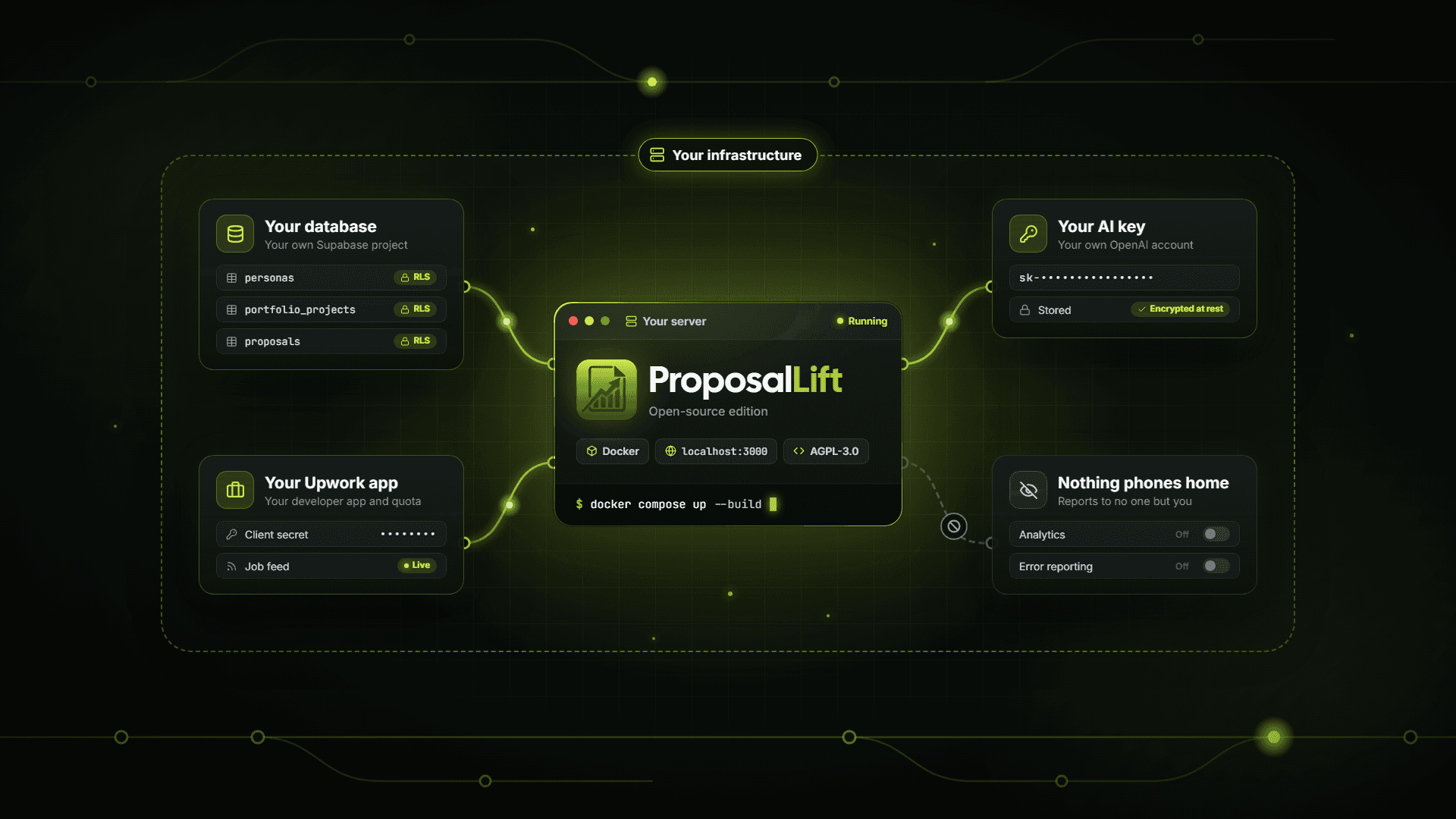
ProposalLift Open Source: A Self-Hosted AI Proposal Writer for Upwork
ProposalLift now has a free, open-source edition you can run on your own server. What it includes, how to set it up, and when hosted plans are the better fit.
 Apr 21, 2026
How to Write Upwork Proposals That Actually Get Hired (2026 Guide)
Learn how to write Upwork proposals that stand out: structure, proof, tone, and mistakes to avoid—plus a repeatable workflow serious freelancers use daily.
 Apr 20, 2026
Upwork Cover Letter Template That Converts (Copy-Paste Framework)
Use this Upwork cover letter framework: opening hook, proof, plan, and CTA—plus examples you can adapt so you sound credible, not like spam or a template.