

How to Win Your First Upwork Job Fast (Without Spamming Proposals)
A practical playbook to land your first Upwork job: profile basics, niche focus, proposal strategy, pricing psychology, and what to do when you’re new.

Your first Upwork job is less about being the “best freelancer in the world” and more about being the least risky choice for a small, concrete task. Clients hiring someone with no reviews are buying uncertainty. Your job is to reduce that uncertainty with clarity, proof, and a believable plan.
Here is a practical playbook that works in the real marketplace—not theory from a decade ago.
Step 1: Pick a lane you can prove today
New profiles compete best when they look focused, not generalist.
Choose:
- One primary service (example: “Shopify speed optimization” not “everything online”).
- One primary proof asset: a portfolio piece, a GitHub repo, a case write-up, a sample video, or a downloadable PDF.
If you have no client work yet, build a credible sample that mirrors real client work. A fictional brand is fine if the execution is strong and clearly labeled as a sample.
Step 2: Upgrade your profile to “trustworthy at a glance”
Clients decide quickly. Make these elements crisp:
- Title: Specific outcome + niche (not a list of 12 skills).
- Overview: First two lines matter most—say who you help, what you deliver, and what makes you credible.
- Portfolio: Fewer, stronger items. Each should explain problem → approach → result.
- Skills: Match what you actually want to be hired for.
Think of your profile as backup evidence. Your proposal gets attention first; your profile confirms it.
Step 3: Apply less—but apply better
The classic beginner mistake is blasting 50 generic proposals. That burns connects, trains you to write badly, and rarely wins.
Instead, run a simple weekly system:
- Shortlist jobs where you can cite directly relevant experience.
- Spend real time customizing the first 5–8 sentences.
- Avoid jobs that are clearly fishing for the lowest price unless you have a strategy.
Quality applications beat quantity—especially when you have no reviews.
Step 4: Write proposals that de-risk the hire
Your first-job proposals should include:
- A tight understanding of the task in the client’s language.
- Proof closest to their need (even if it is a personal project).
- A small milestone suggestion when the job is ambiguous.
Example milestone mindset: “I can deliver X in 48 hours for Y connects-worth of effort” (adapt to your rate and scope—this is the shape of thinking, not a literal quote).
Step 5: Price like a professional, not a panic
Being new does not mean you must be cheapest. It means you must be clear.
If you are discounting to build reviews, do it intentionally:
- Offer a clean scope.
- Communicate what is included.
- Set boundaries on revisions and timelines.
Clients fear messy engagements more than they fear paying a few extra dollars.
Step 6: Speed + communication = secret weapon
Early in your Upwork career, responsiveness matters enormously. Reply fast, ask smart questions, and confirm understanding in writing.
Many first contracts go to the freelancer who makes the client feel safe and heard—not the one with the fanciest adjectives.
Step 7: Ask for the right kind of first job
If you keep losing fixed-price gigs, consider smaller contracts that close faster: a paid audit, a short technical review, a single deliverable milestone.
A fast win gives you a review, a completed contract signal, and momentum.
Common “first job” failure modes
- Looking desperate in proposals (overpromising, begging, huge walls of text).
- Ignoring instructions in the job post (tests, keywords, questions).
- No proof—only claims.
- Applying to wrong-fit jobs where your experience cannot be made relevant without lying.
Where automation helps (and where it does not)
Tools can help you track opportunities, organize job criteria, and draft from structured notes—especially if you are monitoring a job feed daily. What tools cannot do is replace proof and good judgment.
Use automation to reduce admin friction, not to spam templated proposals. On Upwork, “fast” only wins when it is also specific.
The “starter contract” strategy (when you need momentum)
If you keep losing larger projects, you are not failing—you may be aiming at the wrong entry point.
Starter contracts are intentionally small, scoped, and designed to close quickly:
- a 1–2 hour audit
- a single landing section rewrite
- a bug triage + fix list
- a wireframe for one screen flow
Your goal is a completed contract with a strong review and a client who trusts you. Then you upsell thoughtfully.
How to handle “no feedback” without spiraling
Silence is normal. Clients ghost, pause hiring, or pick someone else. Your job is to keep your process high quality even when outcomes are noisy.
A practical mindset:
- Treat each application as a learning artifact
- Improve hooks weekly
- Keep your pipeline filled with new opportunities
Persistence without learning is just repetition.
Red flags for brand-new freelancers (protect your time)
Be extra cautious when:
- The post asks for free work “to prove skill” on a large deliverable
- The client pushes communication off-platform immediately
- The scope is vague but the pressure is high
You can still win, but you should use milestones, clear written scope, and platform protections where appropriate.
First-job checklist (printable)
- My profile title matches the job I want
- My portfolio has at least one strong relevant proof point
- My proposal references the job’s language and constraints
- I include a next step and a smart question
- I followed every instruction in the posting
Conclusion
Winning your first Upwork job is a sales problem with a trust constraint. Narrow your niche, show credible proof, write proposals that reduce client risk, communicate like a pro, and aim for a small, clean first contract you can over-deliver on.
Do that consistently for a few weeks and your first win becomes far more predictable than crossing your fingers and copying generic cover letters.
Speed matters on your first jobs, and so does picking the right ones. ProposalLift's Upwork job alerts watch your saved filters and flag new matching jobs, so you can apply early to posts that actually fit.
Recent blog posts
 Sep 15, 2026
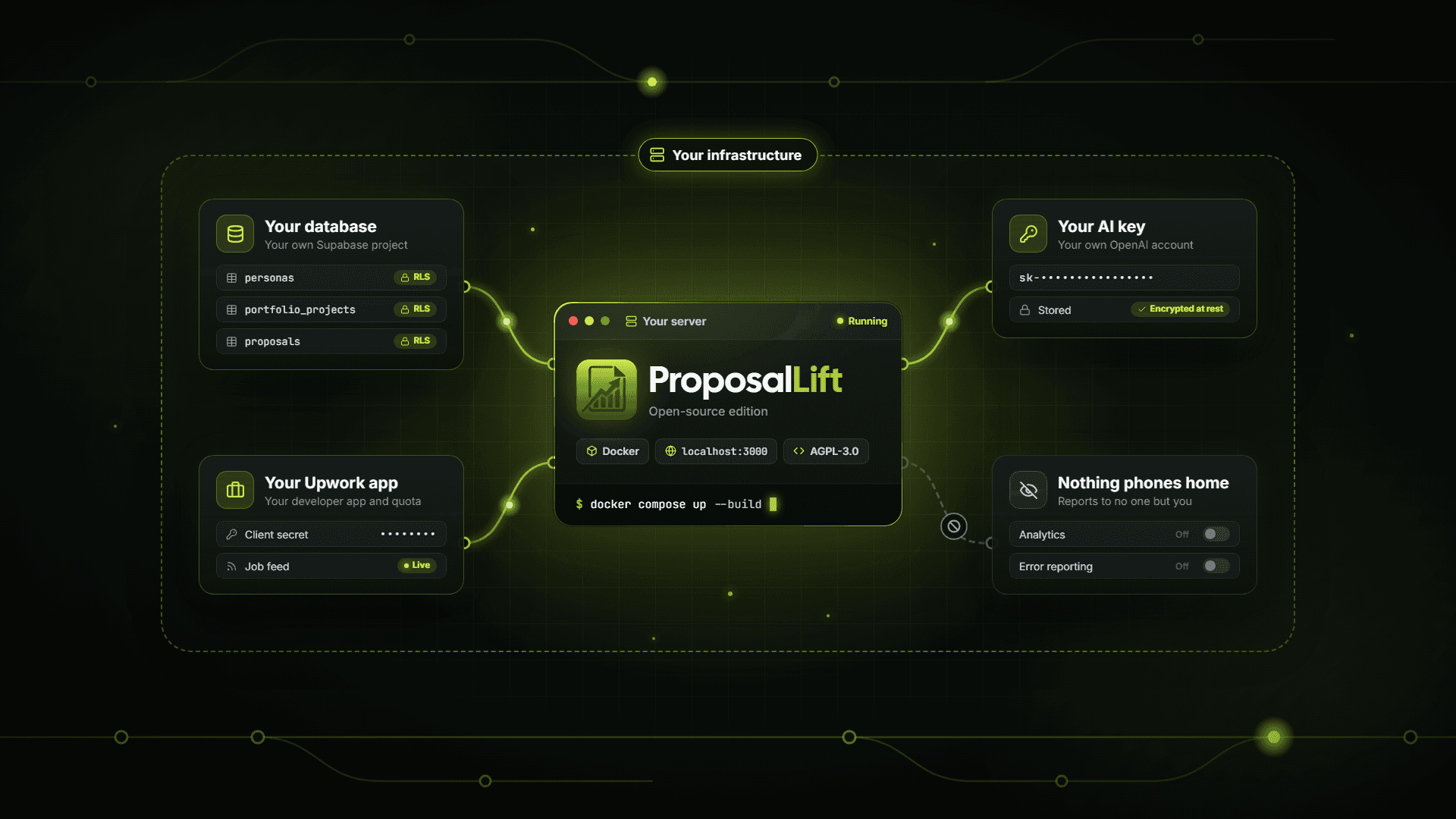
ProposalLift Open Source: A Self-Hosted AI Proposal Writer for Upwork
ProposalLift now has a free, open-source edition you can run on your own server. What it includes, how to set it up, and when hosted plans are the better fit.
 Apr 21, 2026
How to Write Upwork Proposals That Actually Get Hired (2026 Guide)
Learn how to write Upwork proposals that stand out: structure, proof, tone, and mistakes to avoid—plus a repeatable workflow serious freelancers use daily.
 Apr 20, 2026
Upwork Cover Letter Template That Converts (Copy-Paste Framework)
Use this Upwork cover letter framework: opening hook, proof, plan, and CTA—plus examples you can adapt so you sound credible, not like spam or a template.