

Freelance Proposal Writing: 12 Tips Remote Clients Actually Respond To
Freelance proposal writing that wins remote work: clarify outcomes, scope, timelines, and communication—plus examples and a simple outline you can reuse.

Remote clients cannot “feel out” your competence in a hallway conversation. They are buying from text: your profile, your message, your process. That is why freelance proposal writing is not about sounding smart—it is about reducing doubt fast.
These twelve tips are built for real remote hiring: clear scope, believable timelines, and communication that signals you will not disappear mid-project.
1. Start with the outcome, not your credentials
Credentials matter, but they belong after you have shown you understood the assignment. Open with the client’s desired end state.
Why it works: It mirrors how clients think. They are not hiring “a designer”; they are hiring “a checkout flow that does not leak conversions.”
2. Translate features into business language
Clients often describe tasks in mixed detail. Your job is to restate the work in outcomes: revenue, time saved, risk reduced, quality improved.
Example: Instead of “I will configure CI,” try “So deployments stop breaking production—CI catches regressions before release.”
3. Make scope explicit—even if the client was vague
Vague posts are common. You win by proposing a sensible structure:
- Phase 1: Discovery / audit / prototype
- Phase 2: Core build
- Phase 3: Hardening, handoff, documentation
You do not need a formal document in the first message—just enough clarity that the client sees you can lead.
4. Give one proof point that matches the exact risk
If the client is worried about speed, show speed. If they worry about security, show security. Generic portfolios do not soothe specific fears.
Actionable habit: For each job, write down “the fear” in one sentence. Align your proof to that fear.
5. Use a repeatable outline (without sounding templated)
A strong default structure:
- Restate goal
- Clarify approach in 3–5 bullets
- Proof (one story)
- Timeline rough-cut
- What you need from them (assets, access, decisions)
- Next step
Templates fail when your bullets are identical across jobs. The outline should be stable; the content must change.
6. Price with boundaries, not apologies
Remote work goes sideways when scope creeps silently. Your proposal can set norms:
- What is included
- What counts as a revision
- What triggers a change order
You can be friendly and still be clear. Clarity is kindness at a distance.
7. Show communication discipline
Clients fear freelancers who ghost, argue in chat, or need constant hand-holding. Signal your rhythm:
- “I share a short weekly update with blockers.”
- “I respond within one business day for async questions.”
Only promise what you will maintain.
8. Ask one excellent question (not ten)
Multiple questions feel like homework. One sharp question proves expertise and starts a useful conversation.
Good question pattern: clarifies a technical constraint, prioritization, or success metric.
9. Write for skimming: short paragraphs, clean flow
Assume the client is tired. Use short paragraphs. Avoid giant blocks. If you list deliverables, use bullets.
10. Avoid desperate energy
Phrases like “I really need this job” increase perceived risk. Confidence is quieter: you want the project, but you are not collapsing if it does not land.
11. Tailor your tone to the client’s culture cue
Some posts are formal; some are casual. Mirror modestly—professional does not mean stiff if the client writes like a human.
12. End with a proposed next step that fits the job size
Small job: “I can start tomorrow with X deliverable by Friday.”
Larger job: “If helpful, I can send a short milestone plan after a 20-minute call.”
Match the step to the stakes.
A practical example (condensed)
Client wants: migrate a blog from WordPress to a headless setup.
Weak proposal: “I am an experienced developer and I love WordPress.”
Strong proposal: “You want to move off WordPress for performance and easier content workflows while keeping SEO stable. I’d map URL redirects first (to protect rankings), then migrate content with a validation checklist, then cut over DNS during a low-traffic window. Last migration I handled, we avoided duplicate-content issues by staging redirects before launch. If you share traffic patterns, I’ll propose a cutover window and a rollback plan.”
Notice: outcome, plan, proof, operational awareness.
Common freelance proposal myths
-
Myth: Longer proposals look more serious.
Reality: Longer proposals often hide unclear thinking. Tight proposals signal seniority. -
Myth: You must sound “salesy.”
Reality: The best sales feel like clarity. -
Myth: You should accept every job.
Reality: Bad-fit jobs produce bad reviews. Proposals are also a filter for you.
Where a product workflow fits naturally
Freelancers applying on marketplaces often manage: job alerts, job notes, persona angles, portfolio snippets, and follow-ups. When those pieces live in one place—especially with a browser extension for capturing job context—you spend less time reconstructing details and more time tailoring the message.
The point is not to generate generic pitches. It is to keep your thinking consistent while your words stay specific.
Checklist before you hit send
- Did you restate their goal in their vocabulary?
- Did you include at least one concrete proof point?
- Did you make scope and next steps understandable?
- Did you follow any instructions in the post?
- Did you remove filler adjectives?
Remote clients fear: ghosting, chaos, and surprise invoices
Your proposal can directly address those fears without sounding defensive:
- Ghosting: “I’ll share a short weekly update with what shipped, what’s next, and blockers.”
- Chaos: “I’ll keep tasks in a single board/list so decisions do not get lost in chat.”
- Surprise invoices: “If scope changes, I’ll confirm in writing before additional hours.”
You do not need legal language—just operational clarity.
Two proposal styles that work (pick one)
Consultative style works when the client is uncertain. You ask sharp questions, propose discovery, and outline options with tradeoffs.
Executor style works when the client already knows what they want. You confirm requirements, propose milestones, and minimize back-and-forth.
Mismatching styles creates friction. A decisive client may find consultative writing slow; an uncertain client may find executor writing presumptuous.
How to write proposals when you must say “no”
Sometimes the best proposal is honest disqualification:
- “This needs a team with X capability; here’s what I can do instead…”
- “The timeline is not feasible without cutting scope; here’s a realistic phased plan…”
Clients remember freelancers who protect them from bad outcomes—even if they do not hire you immediately.
International clients: clarity beats cleverness
If your client is not a native speaker of your language, prioritize:
- shorter sentences
- fewer idioms
- explicit lists for deliverables
You can still be warm—just be easy to parse.
Conclusion
Freelance proposal writing for remote clients is trust engineering in text form. Lead with outcomes, prove relevance fast, communicate like someone who ships work reliably, and make the next step obvious. Do that repeatedly and your proposals become a compounding asset—because you will keep improving proof, hooks, and positioning with real feedback from the market.
If you want proof-first proposals like these without starting from a blank page every time, ProposalLift's Upwork proposal generator drafts from your own persona, portfolio, and hooks, and you edit and send every proposal yourself.
Recent blog posts
 Sep 15, 2026
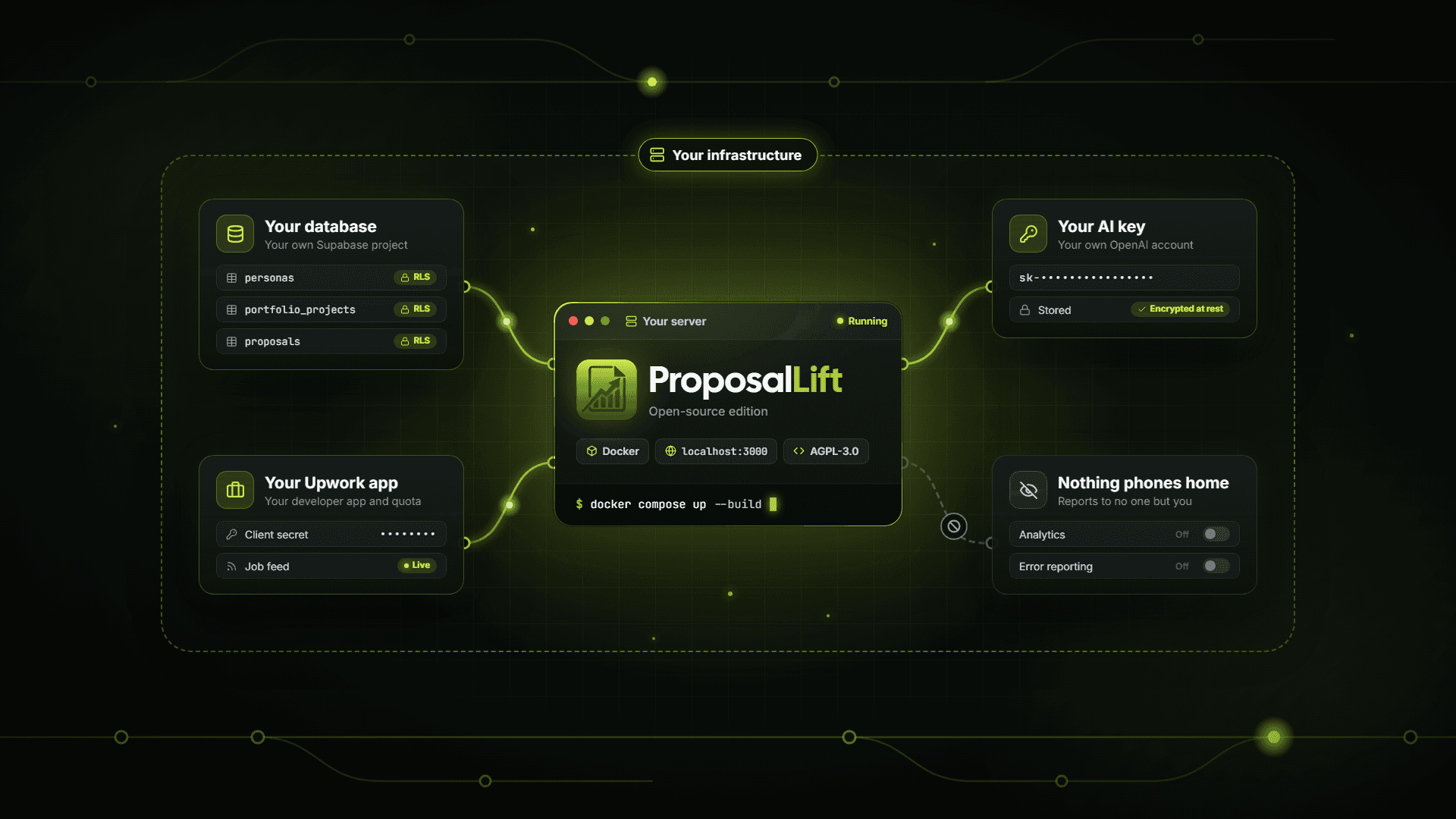
ProposalLift Open Source: A Self-Hosted AI Proposal Writer for Upwork
ProposalLift now has a free, open-source edition you can run on your own server. What it includes, how to set it up, and when hosted plans are the better fit.
 Apr 21, 2026
How to Write Upwork Proposals That Actually Get Hired (2026 Guide)
Learn how to write Upwork proposals that stand out: structure, proof, tone, and mistakes to avoid—plus a repeatable workflow serious freelancers use daily.
 Apr 20, 2026
Upwork Cover Letter Template That Converts (Copy-Paste Framework)
Use this Upwork cover letter framework: opening hook, proof, plan, and CTA—plus examples you can adapt so you sound credible, not like spam or a template.